Making Metal Clash: finding the vibe
For my first post here, I wanted to start with something I find really exciting: making games.
First, a disclaimer: none of this prose was written by AI. That’s right; it is a brain dump from me to you, dear reader. (Disclaimer of the disclaimer: I did everything else with AI; the link embeds, the blog architecture, the 3js scenes, etc. I’m not a caveman.)
Ever since I first started dreaming up new games, I’ve been limited in which of those dreams I could usher into reality, to the extent that anything can be real in digital space. For the record, I consider “virtual reality” to be just as real as “meatspace”, but let’s not get off topic too quickly.
At first, my limitations were a lack of the basic skills and knowledge needed to create games. I learned those skills by creating really stupid maps in the old Activision RTS Dark Reign and figuring out why they were stupid. For example, I remember creating a nearly empty map and filling it with these earthquake units operated by a CPU opponent, with just one scout vehicle for me, to see if I could make it all the way around the map without getting crushed under overlapping shockwaves.
I mean, one part of me is like, “So what if that was dumb? It was fun.” And yeah, it was absolutely worth doing just for the joy of seeing all those explosive shockwaves. But that didn’t make it a great gameplay loop.
Anyway, fast-forward to where I am today: Metal Clash is a game I’m working on where you have these two giant mechs facing off in fast-paced battles. I’m building the engine, the game loop, and the art all with the help of Claude and ChatGPT, with a little DeepSeek V4.1 Flash filling in usage limit gaps.
The thing is, none of those AIs have a good sense of what makes a game fun. They can slap together working systems with insane competency but they just can’t understand how to hit a vibe.
This, I think, is the key to understanding what AI “slop” is: when the human designer is so caught up in the wonder of what the technology can do that they leave those vibes at the door and just let the AI steer.
I’m not saying what I’ve built so far will be the next smash hit, but when my two sons are testing it for me and squealing with delight as they blow off the enemy mech’s arm in a blazing fireball, I feel like I’ve successfully landed on a vibe.
I think that’s the most rewarding thing about this whole process: watching how people react to what I’ve made. And yeah, even though I’ve made extensive use of AI in the process, I still consider it mine. Because here’s the thing: if it were so easy to make something good and fun with AI, everyone would be doing that, and “slop” would not be a thing. I’ve put something significant into the build beyond what the software can do.
The stack
Back to the build. My stack is a Godot base, with C++ simulation code to keep the gameplay loop tight and deterministic (necessary for the eventual netcode), and GDScript for the game code. Once I get to the netcode and multiplayer features, I’ll need a database (probably Turso), but we’re not quite there yet.
The art pipeline
The graphics I’ve found to be the most interesting part. Everything is in the retro 16-bit style that harks back to my childhood memories of blasting away with a bazooka-like lightgun at an old CRT screen on Christmas Day in the nineties. I wanted to keep things simple so I could learn how to set up a graphics pipeline using agents, nostalgia beats notwithstanding.
And a pipeline is exactly what I made. At first I tried letting the AI produce code-generated pixels, and that worked fine for initial prototypes, but they looked rather flat and uninspired. So I decided that a diffusion imagegen model might produce better results that I could then have Claude chop up into component pieces (you know, for the arm explodey thing).
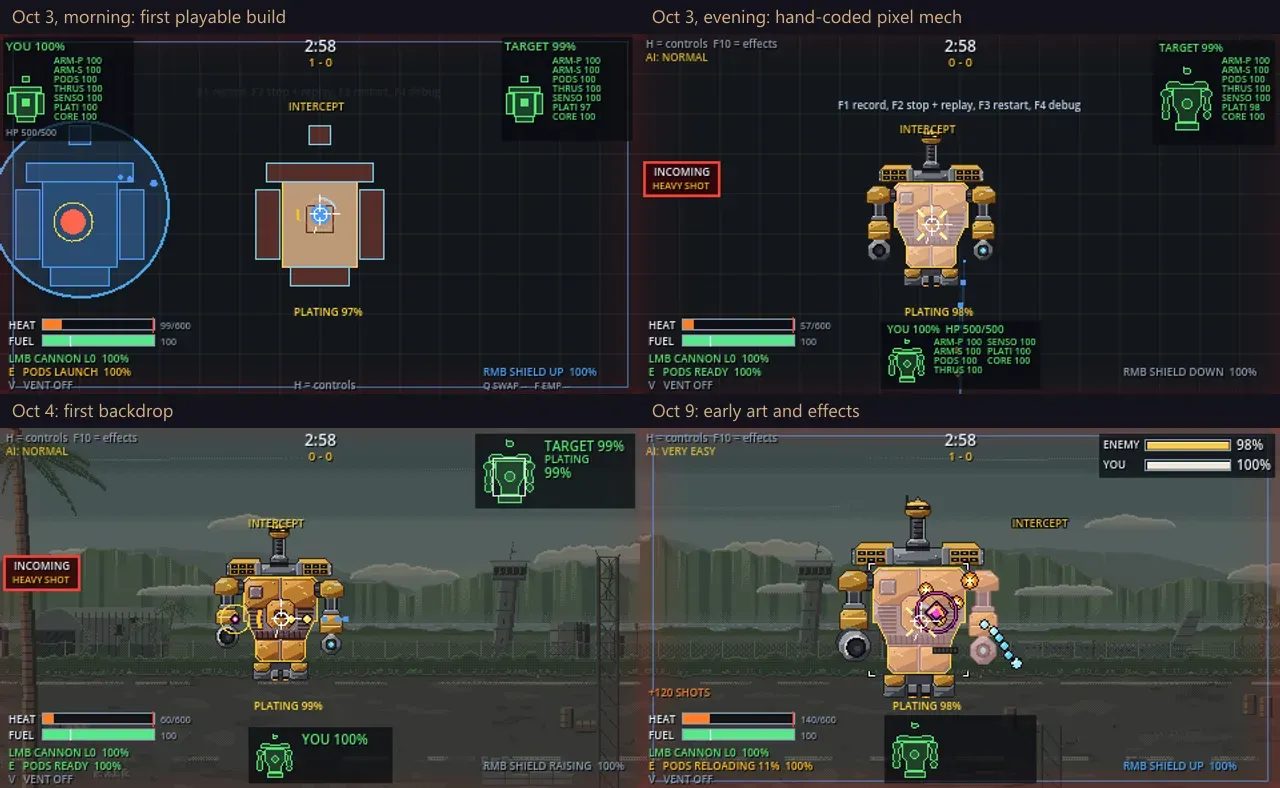
Much better, but my initial model choice was an open-weight, free model I found that worked with my laptop’s rather elderly RTX 2070 through a ComfyUI workflow. Rapid prototyping, yes, but definitely not great for matching those childhood memories.
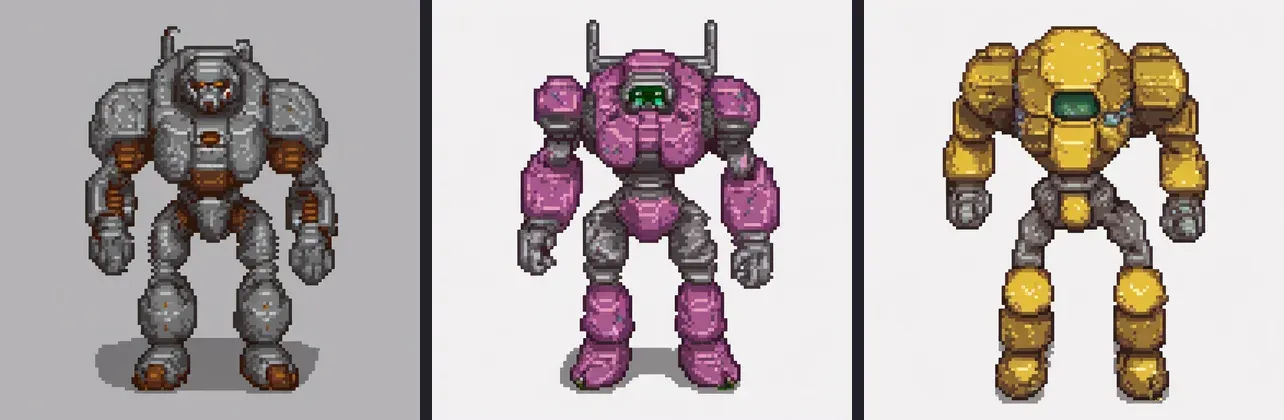
Eventually, I picked up a ChatGPT Pro subscription, because I heard about their included imagegen model. Turns out they also ship that with a CLI, which means it works nicely with the multi-agent Claude workflows I already had in place. There’s nothing that throws molasses on your build pace like having to pull up a web browser and hand-prompt an imagegen model for the thirtieth iteration of a mech’s left sabaton.
Claude as the backbone
Speaking of Claude, that’s the backbone of my process. I started by using Opus 5 to produce the GDD for Metal Clash. That got all of the major decisions locked in and the build path laid out. Now that document sits as a kind of Bible or constitution to which my agents all refer when they are doing feature work. I’ve upgraded to Opus 5.5 since then, which has been a major improvement, but the GDD remains invaluable regardless.
Besides that, I have two artifacts Claude generated to help me manage the build.
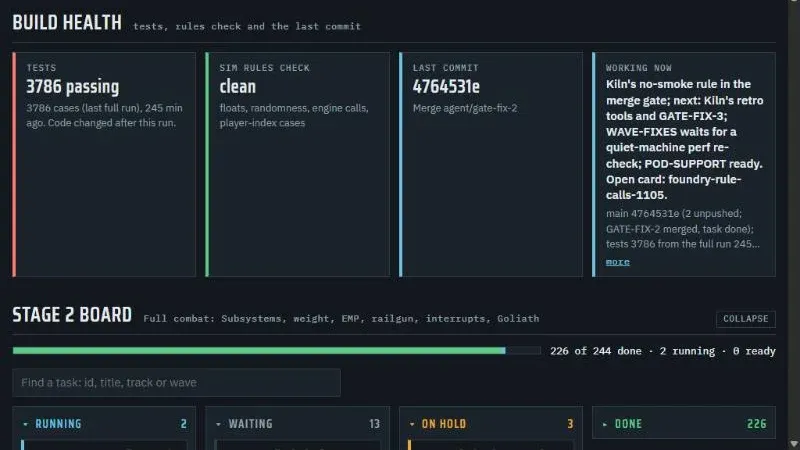
The first I call my Build Board. It’s a dashboard that tracks my current stage milestones, decisions the agents are waiting for me to make, animated GIF recordings of recent gameplay so I can track progress at a glance, and various tools and skills I’ve added to the harness so I don’t forget about them later.
The second is my Art Review board. This is where the imagegen art gets piped for me to review, approve, reject, or request changes. And boy, does it get piped. I have nearly 750 sprite sheets that have gone through that board so far and counting. It probably would have taken me months to generate that many by hand in a browser and probably years to draft them myself. I’m not even at day 30 on my ChatGPT sub as of this writing.
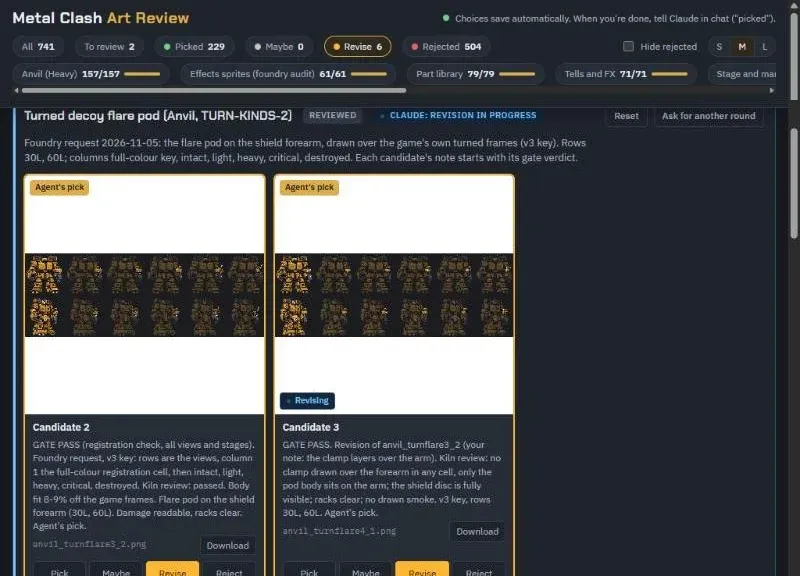
So yes, I still review every piece of art that lands in the actual game. I know that slows things down considerably, but I’m glad I do it. Here’s another example of why you really can’t trust agents to find a proper vibe:
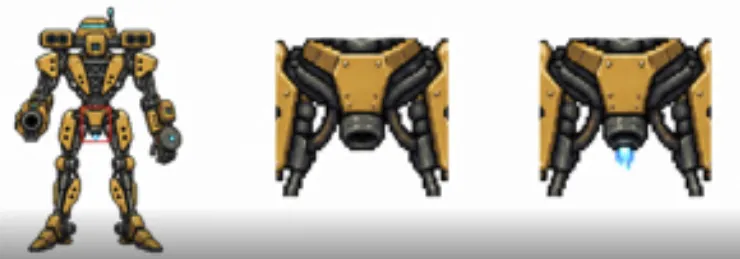
Yes, that was really one of the proposed images. Needless to say, that became its own rule in the agent instructions.

That seems like a good stopping place for this post. I plan to have more of these in the future, so stay tuned.